
- Home
- Why Now
THE RIGHT TECHNOLOGY AT THE RIGHT MOMENT
America is approaching a behavioral-health inflection point.
America is approaching a behavioral-health inflection point.
The problem is no longer simply whether treatment exists.
The question is whether treatment can meet people where, when, and how they are willing to engage.
Each year, the nation’s local jails record approximately 7.9 million admissions
In 2024, approximately 52.6 million Americans age 12 or older were classified as needing substance-use treatment.
Of those with a substance-use disorder, approximately 42.4 million did not receive substance-use treatment.
Selected data sources: U.S. Department of Justice, Bureau of Justice Statistics, Jail Inmates in 2024 - Statistical Tables. SAMHSA, 2024 National Survey on Drug Use and Health (NSDUH), Annual National Report.
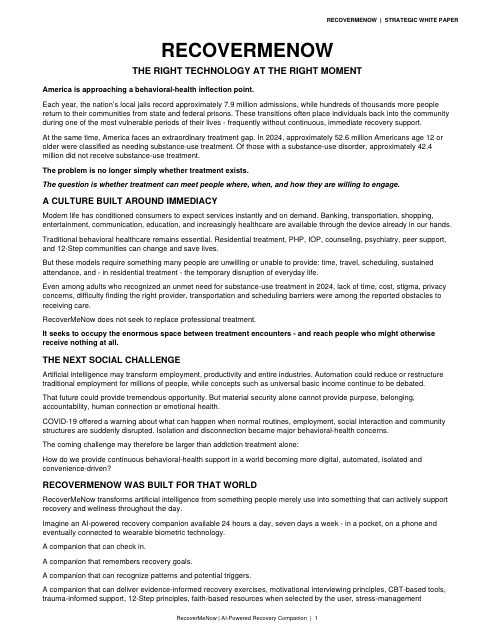
Each year, the nation’s local jails record approximately 7.9 million admissions, while hundreds of thousands more people return to their communities from state and federal prisons. These transitions often place individuals back into the community during one of the most vulnerable periods of their lives - frequently without continuous, immediate recovery support.
At the same time, America faces an extraordinary treatment gap. In 2024, approximately 52.6 million Americans age 12 or older were classified as needing substance-use treatment. Of those with a substance-use disorder, approximately 42.4 million did not receive substance-use treatment.
RecoverMeNow does not seek to replace professional treatment. It seeks to occupy the enormous space between treatment encounters - and reach people who might otherwise receive nothing at all.
Modern life has conditioned consumers to expect services instantly and on demand. Banking, transportation, shopping, entertainment, communication, education, and increasingly healthcare are available through the device already in our hands.
Traditional behavioral healthcare remains essential. Residential treatment, PHP, IOP, counseling, psychiatry, peer support, and 12-Step communities can change and save lives.
But these models require something many people are unwilling or unable to provide: time, travel, scheduling, sustained attendance, and - in residential treatment - the temporary disruption of everyday life.
Even among adults who recognized an unmet need for substance-use treatment in 2024, lack of time, cost, stigma, privacy concerns, difficulty finding the right provider, transportation and scheduling barriers were among the reported obstacles to receiving care.
Artificial intelligence may transform employment, productivity and entire industries. Automation could reduce or restructure traditional employment for millions of people, while concepts such as universal basic income continue to be debated.
That future could provide tremendous opportunity. But material security alone cannot provide purpose, belonging, accountability, human connection or emotional health.
COVID-19 offered a warning about what can happen when normal routines, employment, social interaction and community structures are suddenly disrupted. Isolation and disconnection became major behavioral-health concerns.
The coming challenge may therefore be larger than addiction treatment alone:
How do we provide continuous behavioral-health support in a world becoming more digital, automated, isolated and convenience-driven?
RecoverMeNow transforms artificial intelligence from something people merely use into something that can actively support recovery and wellness throughout the day.
Imagine an AI-powered recovery companion available 24 hours a day, seven days a week - in a pocket, on a phone and eventually connected to wearable biometric technology.
A companion that can check in.
A companion that remembers recovery goals.
A companion that can recognize patterns and potential triggers.
A companion that can deliver evidence-informed recovery exercises, motivational interviewing principles, CBT-based tools, trauma-informed support, 12-Step principles, faith-based resources when selected by the user, stress-management techniques, sleep and wellness support, and personalized recovery education.
A companion that can encourage the user to contact a sponsor, counselor, peer, family member, clinician or emergency resource when human intervention is needed.
And eventually, through appropriate wearable integrations and user consent, a system capable of responding not only to scheduled check-ins but to changes in sleep, activity, stress indicators and other available biometric signals.
Not once a week. Not only during office hours. At the moment support may matter most.
RecoverMeNow is designed around the other hours.
Where support stops today
- TherapistA therapist may see someone for an hour.
- IOPAn IOP may engage someone several hours a week.
- ResidentialA residential program may provide extraordinary structure - but only while that person remains within the program.

The other hours
That is the gap RecoverMeNow is designed to fill.
AI SHOULD NOT REPLACE HUMAN CONNECTION. IT SHOULD HELP PEOPLE REACH IT.
RecoverMeNow's vision is not an artificial therapist replacing clinicians, physicians, sponsors, treatment programs or human relationships.
It is a 24/7 intelligent recovery companion designed to strengthen those relationships, reinforce learned skills, identify moments when additional support may be needed, and make the next healthy action easier to take.
“Will the person come to us?”
“What if meaningful recovery support could go with them?”
That is why the opportunity for RecoverMeNow exists now.
The convergence of artificial intelligence, smartphones, wearable technology, enormous unmet behavioral-health need, justice-system reentry, changing patterns of human interaction, and consumer demand for immediate personalized services has created a moment that did not exist a decade ago.
RecoverMeNow is being designed for that moment: Recovery support that is personal. Recovery support that is intelligent. Recovery support that is available when life actually happens.
Selected data sources
• U.S. Department of Justice, Bureau of Justice Statistics, Jail Inmates in 2024 - Statistical Tables.
• SAMHSA, 2024 National Survey on Drug Use and Health (NSDUH), Annual National Report.
Take the white paper with you.
RecoverMeNow is being designed for that moment: Recovery support that is personal. Recovery support that is intelligent. Recovery support that is available when life actually happens.